
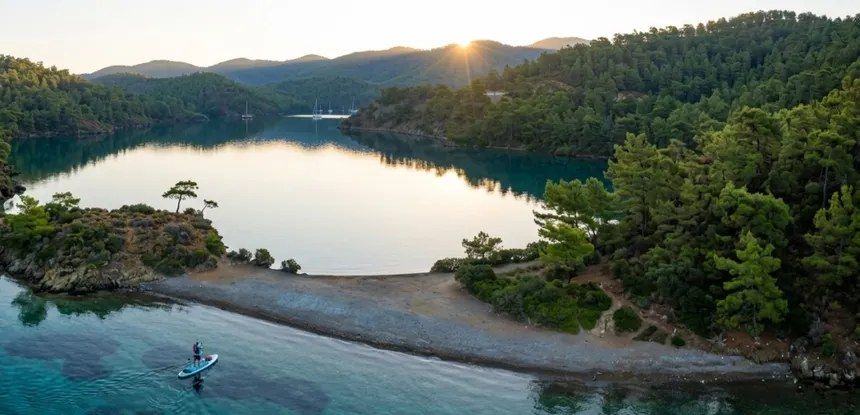
Göcek sits at the head of the Fethiye Gulf on Turkey's south-west coast, between Dalaman and Fethiye. The gulf holds twelve islands and a coastline of narrow coves backed by pine forest, close enough together that a yacht can move between anchorages in minutes and still find a different view each evening.
What distinguishes Göcek is not its beauty, which is shared by much of the Turquoise Coast, but the way it is protected. The area was declared a specially protected area in 1988, which has kept multi-storey building off the shoreline. The result is a coast where the hills are still forest rather than villas.
Where we go
- Tersane Island, with the remains of tombs, churches and an old dockyard, and an abandoned village on its slopes.
- Bedri Rahmi Bay, enclosed by forested cliffs, with Lycian tombs above the water.
- Cleopatra's Baths, where ruins lie in the shallows.
- Sarsala Bay and Kille Bükü, deeper inlets surrounded by pine forest, quieter outside the peak weeks.
- The Yassıca Islands, a cluster of low islands in shallow, clear water.
Why it suits a private yacht
The gulf is sheltered, the distances are short, and the town has an unusual concentration of marinas for its size, six in all, so provisioning, crew changes and guest arrivals can be arranged without leaving the gulf. Guests can arrive through Dalaman airport, along the coast road. For principals who want several days at anchor with family or counterparts, and little need to be seen ashore, it is one of the most practical stretches of the eastern Mediterranean.
Practical notes
- The gulf lies within a protected zone. In some coves, anchoring is restricted to protect the seabed and only designated moorings may be used, and discharge of black water and bilge water is prohibited. Rules on speed, music and access to some historic sites also apply. Current rules should be confirmed with the yacht's agent before arrival.
- Many coves are best used with a stern line ashore; the crew should be familiar with Turkish practice.
- The quietest weeks are early and late in the season. July and August bring the most traffic.
- Turkish cabotage, charter and customs rules differ from those of EU waters, and should be checked before a charter or a change of guests in Turkey.
General information for planning only. Regulations change and must be confirmed locally.