
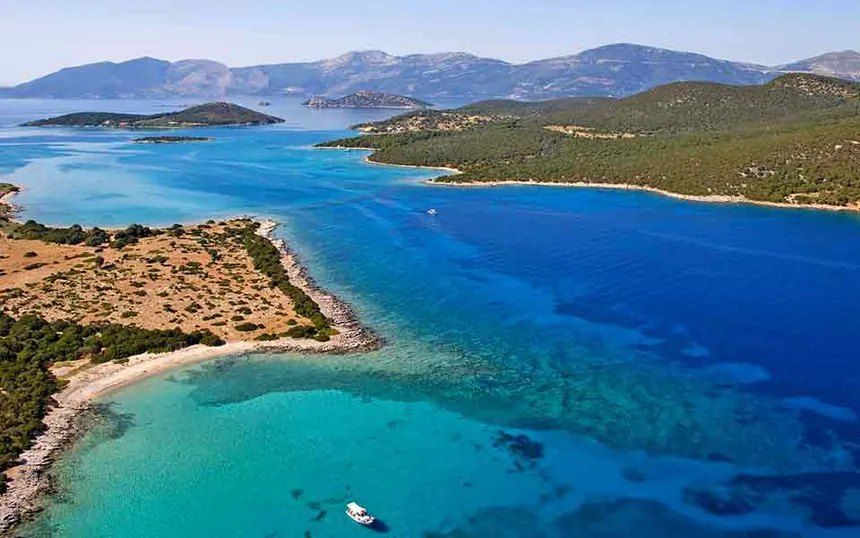
Most yachts leaving Athens turn south-east for the Cyclades and pass the southern tip of Evia without stopping. That is its appeal. Greece's second-largest island is better known to Athenians than to visitors, and its southern coast, around Karystos, remains quiet in high summer.
The Petalioi
Off the southern coast of Evia lies the Petalioi group: ten islands and islets, almost all uninhabited, with the largest, Megalonisos, covering some 17 square kilometres. The islands were sold by the Greek royal family to the shipowner Maris Embiricos in the years around 1915 and remain in the private ownership of Greek shipping families. They are, in effect, a private archipelago a short passage from the Attic coast.
Landing ashore is a matter for the owners and should not be assumed. The value for a yacht is the water around them: sheltered anchorages, clear sand, and very few other vessels.
Karystos and the south coast
Karystos is a working harbour town beneath Mount Ochi, with a medieval castle on the hill above it. In a northerly, yachts anchor off the town to the east, near the small fort, in sand. Further east, Kastri offers shelter from the meltemi, though swell can work into the cove when it blows hard. The coast between is largely undeveloped.
Why it suits a private yacht
It is close to Athens, so guests can join for a day or two without a flight, yet it lies outside the usual routes. For a family that wants time at anchor rather than a programme of islands, the combination of the Petalioi and the south Evia coast offers privacy within reach of the capital.
Practical notes
- The Kafireas Strait, between Cape Kafireas (Cavo Doro) and Andros, has a long-standing reputation as one of the most demanding passages in the Aegean in strong northerlies. Passage planning should allow for it.
- Strong gusts can come down into Karystos Bay in a hard northerly; choose anchorages with that in mind.
- Greek cruising tax and charter rules apply; the yacht's agent should confirm the position before arrival.
General information for planning only. Conditions and regulations must be confirmed locally.